

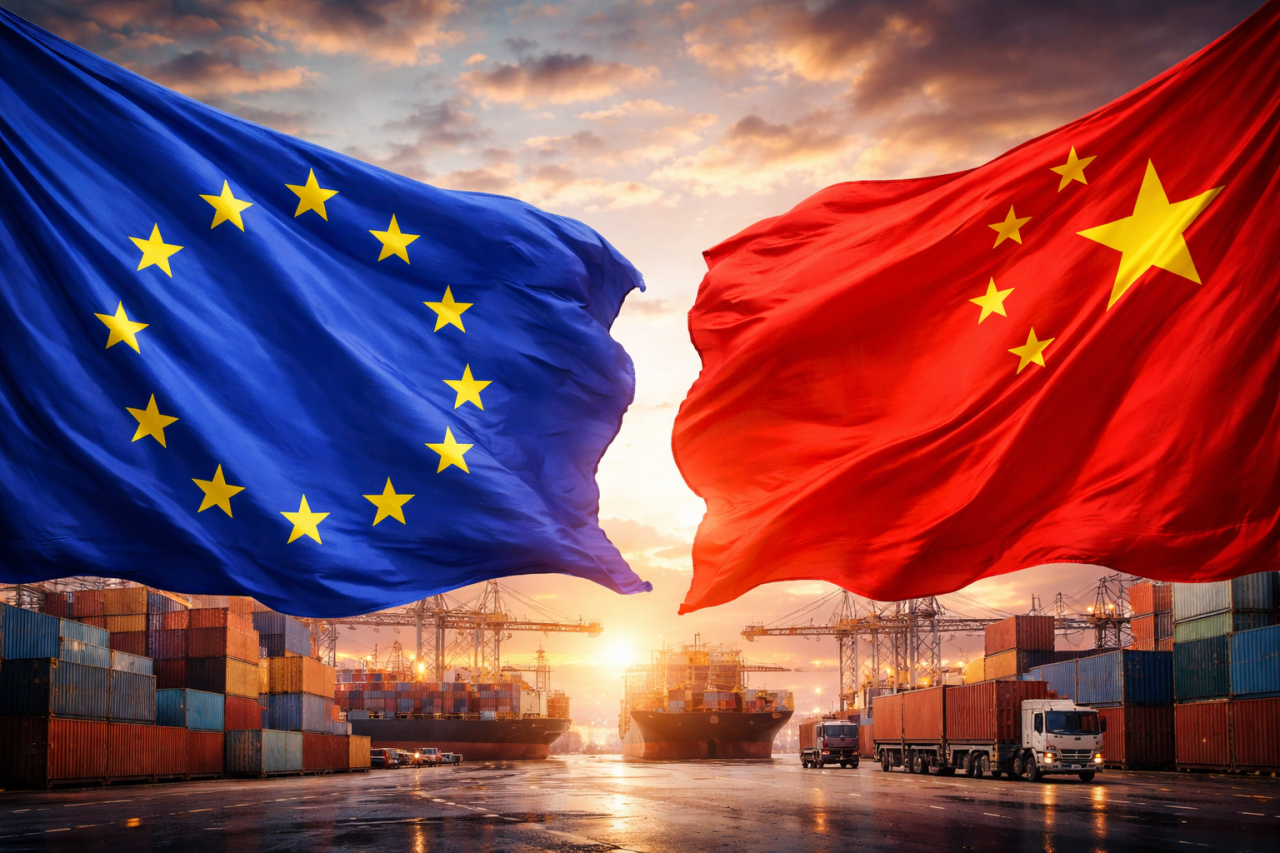
For the past few decades, Europe treated cheap Chinese imports as a mixed blessing.
They squeezed margins in some industries, but kept inflation low and consumers happy. But the trade-off no longer exists.
As domestic demand weakens in China, exports have become a release valve, and Europe is absorbing that flow.
What European manufacturers are confronting now is not just price competition, but a shock that is affecting production lines, investment, and political risk across the continent.
This time, the pressure is broader, faster, and harder to ignore.
Tariffs changed the mix, not the outcome
When the European Union raised tariffs on Chinese battery electric vehicles in 2024, the goal was to curb imports by raising prices.
Early estimates suggested shipments would fall sharply.
Instead, Chinese car exports to Europe rose to nearly 1.2 million vehicles in the twelve months to November, up roughly a quarter from a year earlier.
The reason is not hard to trace. The EU’s tariffs applied narrowly to fully electric cars and varied by manufacturer.
Hybrids were left untouched. Chinese carmakers responded by shifting their export strategy.
Sales data show that while Chinese electric vehicle shipments to Europe continued to rise at a moderate pace, exports of hybrids surged far faster.
Within a year, Chinese brands moved from the margins to account for a meaningful share of Europe’s hybrid market.
The regulation worked exactly as written. It just did not work as intended.
This pattern matters beyond cars. It shows how quickly Chinese firms can adjust product lines, pricing, and market focus to preserve volume.
When protection pushes production inside Europe
Tariffs did not stop Chinese expansion; they just redirected it.
Rather than pulling back, several Chinese automakers like BYD accelerated plans to build inside the EU.
From a European perspective, this creates an uncomfortable trade-off. Local factories bring jobs, tax revenue, and supply contracts.
They also embed Chinese platforms, software, and battery systems into Europe’s industrial base.
The political optics are easier than import surges. The strategic implications are harder to unwind.
Once production sits inside the single market, tariffs lose relevance and leverage shifts elsewhere.
When competition turns into dependence
European industry has long competed with China on price. What changed in 2025 was the realisation that price is no longer the only variable. Supply security has entered the equation.
In October, Chinese authorities imposed export licensing requirements on several rare earth elements used in motors and electronics.
Days later, exports of certain computer chips were restricted. Several manufacturers warned of potential production stoppages.
Some German firms temporarily placed workers on leave.
And while the immediate disruption was limited, some parts are permanently affected.
Licensing regimes allow shipments to continue, but slowly and selectively.
For manufacturers, that creates uncertainty that ripples through procurement, inventory planning, and capital spending.
The concern is not a full cutoff, but a future where inputs arrive just late enough to disrupt output.
According to Bundesbank estimates, almost half of German manufacturers rely on inputs from China.
That dependence was tolerated when trade felt stable. It looks far riskier when access can be adjusted administratively.
The trade balance is changing faster than expected
Europe’s exposure is not only about inputs. It is also about where finished goods are coming from, and where European producers are losing ground.
Germany’s trade deficit with China reached €66 billion last year and is already at €87 billion in 2025.
The reliance has been driven by a collapse in German exports to China alongside a surge in imports, notably in cars, machinery, and chemicals, sectors once dominated by European firms.
China’s trade surplus with Europe also keeps increasing, and quickly.
The redirection of Chinese exports has accelerated this trend. As shipments to the United States fell sharply after new tariffs and policy uncertainty, exports to Europe rose.
September marked the strongest month on record for Chinese car sales in Europe.
Chinese brands now account for roughly 20% of Europe’s hybrid vehicle market and more than 10% of electric vehicle sales, according to industry data.
At the same time, German carmakers’ share of the Chinese market has fallen sharply from its peak earlier this decade.
This is all about scale. Manufacturing competitiveness depends on volume.
Losing domestic market share reduces pricing power, investment capacity, and long-term innovation.
Deiundustrialisation?
At the European level, some argue that the risks are overstated. Manufacturing accounts for about 16% of EU GDP, far less than services.
Even in Germany, it is closer to 20%. Models suggest that labour and capital can redeploy, limiting the macroeconomic damage.
That argument misses how industrial decline is experienced.
Manufacturing is geographically concentrated. It anchors regional economies, training systems, and supplier networks.
When output shrinks, the impact is immediate for specific towns and workforces, even if national GDP barely moves.
This is why surveys cited by German research institutes show that around half of industrial firms facing Chinese competition plan to cut output or jobs. The response is operational.
Deindustrialisation may look mild in aggregate data. It feels severe where it happens.
Security is changing how Europe thinks about factories
The debate has also changed because security concerns have sharpened.
Europe is rearming while facing an unpredictable external environment and a more assertive Russia.
Modern defence capacity cannot be conjured from procurement budgets alone.
It depends on civilian manufacturing ecosystems that can be scaled, repurposed, and supplied quickly.
Vehicles, electronics, chemicals, and machinery matter long before a crisis arrives.
Allowing these capabilities to erode narrows options. This is why industrial policy, once treated as an economic issue, is now discussed alongside defence planning.
The concern is not that Europe must outproduce China. Europe must retain enough industrial depth to avoid strategic vulnerability.
Europe’s response is fragmented by design
On paper, the European Union has tools. Anti-dumping measures. Investment screening. Tariffs.
An anti-coercion instrument designed to respond to economic pressure. In practice, unity is hard to achieve.
Some member states benefit from Chinese investment and are reluctant to confront Beijing.
Hungary alone accounted for 44% of Chinese investment into the EU in 2023. BYD is building a large electric vehicle factory there.
Others, particularly Germany and parts of Central Europe, face direct competitive pressure.
Large European multinationals are also split. Firms deeply invested in China worry about retaliation.
Others want stronger protection at home. Governments balance industrial risk against diplomatic and commercial exposure.
This fragmentation slows response and weakens deterrence.
What Europe is really deciding
Europe is not deciding whether to “win” or “lose” against China. It is deciding how much industrial capacity it is willing to trade for lower prices, and how much risk it is prepared to carry in exchange for efficiency.
Trade defences alone will not solve the problem. Neither deregulation nor competitiveness reforms by themselves.
But doing nothing is also a choice, one that shifts adjustment costs onto workers, regions, and future governments.
The uncomfortable reality is that China’s export surge is not an anomaly. It is the outward expression of stress elsewhere.
Europe cannot control that. What it can control is how exposed it chooses to be.
Cheap goods once felt like a gift. Europe is now discovering the bill comes due in factories.
The post How China’s export push is rewriting Europe’s industrial future appeared first on Invezz